
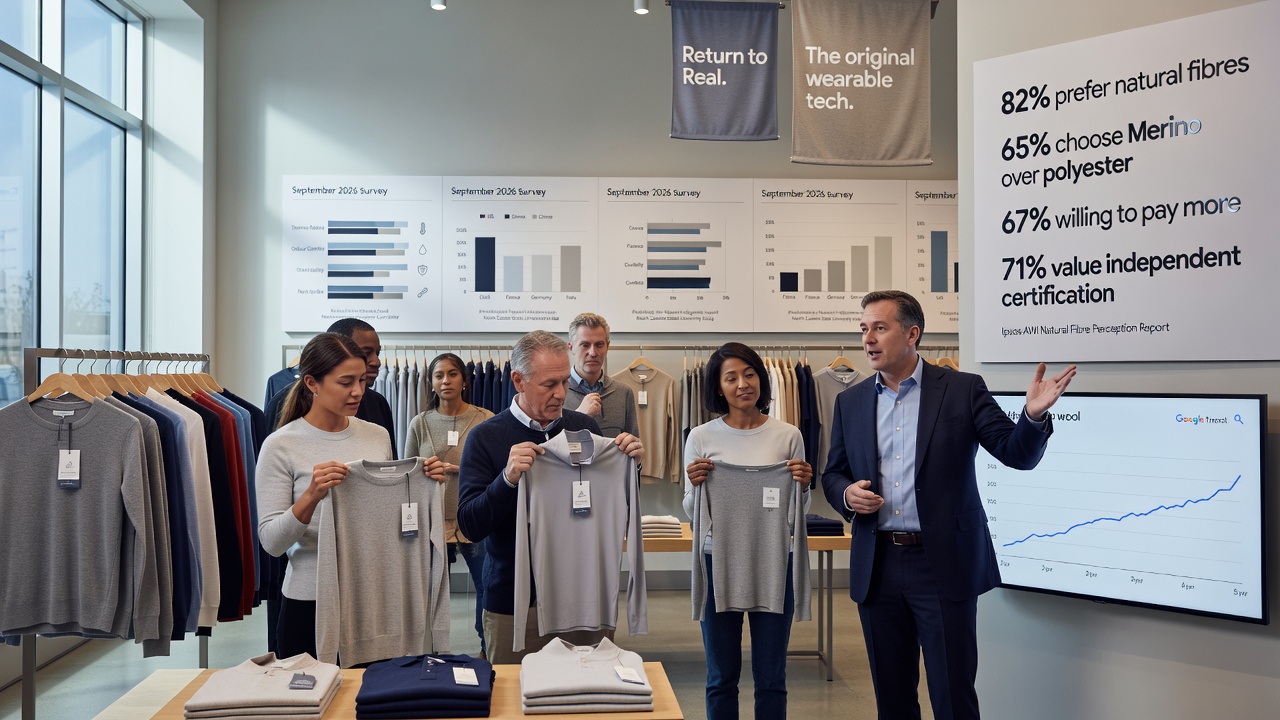
Woolmark, the wool industry's brand and certification body, has launched Return to Real, a global platform promoting Merino wool. The push rests on new consumer research across five markets, including the United States, which suggests shoppers still prefer natural fibres when price, style and fit are comparable.
What the Ipsos Research Found
The Ipsos AWI Natural Fibre Perception Report, commissioned by Woolmark, surveyed 300 online respondents aged 18 to 65 in each of five markets: China, France, Germany, Italy and the United States. Fieldwork took place on September 7 and 8, 2026. Across the five markets, an average of 82 per cent of consumers said they preferred natural fibres to synthetics when price, style and fit were equal. Merino wool was preferred to polyester in every surveyed market, with an average preference of 65 per cent.
The study also asked about money and verification. On average, 67 per cent of consumers said they would pay more for clothing made mainly from natural fibres. Some 71 per cent said independent certification or verification of fibre content and quality mattered to them. Woolmark also reports that worldwide Google search interest in "Merino wool" has more than doubled over the past five years.
Why Fibre Labels and Evidence Matter
Bryan Fry, managing director of Woolmark, framed the campaign around trust. Shoppers, he said, want to know what a garment is made from, how that material behaves in daily use, and whether marketing claims hold up. For a household buyer, that means a label reading "Merino" or "100% wool" tells only part of the story. Independent certification and testing are the checks that connect a label to measurable quality.
Woolmark says it has funded research, testing, education and certification for more than 60 years. Its new Natural Intelligence report looks at thermal comfort, moisture and odour management, durability and next-to-skin comfort. One cited study, a four-year project with North Carolina State University, found that 100 per cent Merino base layers helped keep a more stable microclimate against the skin during stop-start activity.
Reading the Limits of the Claims
These figures come from a campaign sponsor, and the survey measures stated preference, not actual purchases. A respondent saying they would pay more is not the same as paying more at a checkout counter. The sample of 300 per market is modest, and the wording of the questions is not reproduced in the material available here. The North Carolina State study describes base layers in a specific activity context; it does not establish how any given garment will perform for a given wearer.
Practical buyers can use the research as a prompt to check labels, ask for fibre content, and look for third-party certification before paying a premium. The campaign's slogans, such as "The original wearable tech," are marketing language rather than measured findings. Treat the underlying data as one input among others when deciding what to buy.